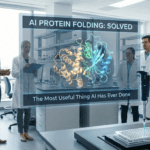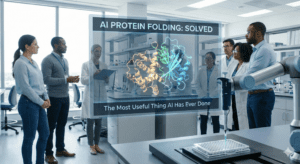
The Problem: Protein Folding
- Complexity: Proteins are strings of amino acids that fold into complex 3D shapes. This shape determines their function (e.g., hemoglobin carrying oxygen, enzymes digesting food).
- The Challenge: Determining this 3D structure experimentally (via X-ray crystallography) is slow, expensive, and difficult. For 60 years, scientists had only solved ~150,000 structures.
- Levinthal’s Paradox: A small protein could theoretically fold in an astronomical number of ways. A brute-force computer check would take longer than the age of the universe.
The Solution: AlphaFold
- AlphaFold 1: DeepMind’s first attempt used deep neural networks trained on the Protein Data Bank (PDB) and evolutionary data (co-evolution of amino acids) to predict structures. It won the CASP13 competition but didn’t reach experimental accuracy (score of ~70/100).
- AlphaFold 2: A complete redesign led by John Jumper.
- The “Evoformer”: A new architecture inspired by Transformers (like in ChatGPT). It uses “attention” mechanisms to process evolutionary data and geometric relationships simultaneously in two communicating “towers.”
- Iterative Refinement: The model recycles its predictions to refine them multiple times before outputting a final structure.
- Structure Module: Instead of treating the protein as a fixed chain from the start, it treats amino acids as a “gas” that settles into place, allowing the chain structure to emerge naturally.
The Result: A Scientific Revolution
- Performance: In CASP14 (2020), AlphaFold 2 achieved a median score above 90, effectively solving the problem. Its predictions were often indistinguishable from experimental results.
- Scale: DeepMind released the structures of 200 million proteins—nearly every protein known to science—essentially advancing the field by decades in just a few years.
- Impact:
- Accelerating drug discovery (e.g., malaria vaccines, antibiotic resistance).
- Understanding diseases like cancer and schizophrenia.
- Helping conservation by mapping proteins of endangered species.
Beyond Folding: Designing New Proteins
- The video also highlights David Baker (University of Washington), who shared the 2024 Nobel Prize in Chemistry with the DeepMind team.
- RFdiffusion: Baker’s team uses generative AI (similar to DALL-E but for proteins) to design new proteins from scratch that don’t exist in nature.
- Applications: Creating custom antivenoms, enzymes to break down plastic, or proteins to capture greenhouse gases.
Conclusion
AlphaFold represents a “step function” leap in science. It shows how AI can unlock fundamental roadblocks (root problems) in knowledge, enabling a cascade of new discoveries in biology, medicine, and materials science that will benefit humanity for decades.
I remember the day the alphafold 2 paper was published, my structural biology teachers were joking around saying like “we’re out of a job now”. Also, after a little while, we actually started using it in classes, it was impressive to see this fast of an adoption into the curriculum ! It actually felt like we lived through one of the big discoveries of our lifetimes.
A very long time ago I attended some local tech convention. All the lectures were the usual half marketing half actual tech talks. But there was one, highly unpopular lecture I attended about protein folding. I distinctly remember the lecturer, who was a professor of biology (can’t remember the exact field) saying: we know how to fold proteins, but we’re limited by compute power. I need people to help us figure out how to properly create efficient compute clusters. Obviously, this was long before AI was where it is today.
I’m an organic chemist and I’ve lived through amazing changes in this science. I’ve seen nuclear magnetic resonance (NMR) instruments evolve into imaging machines (MRI) that can literally allow us to look into living bodies and save countless lives by the coupling of mathematics, physics, and computing power. What a journey! And yet I fell like we have just scratched the surface. Lets hope the future will be bright. It has that potential if we can use these technologies for the good of mankind.
Something that boggles my mind here is just what an incredible amount of knowledge that went into this process. We had to understand biological evolution, chemistry, x-ray defraction, computer programming, genetics… and probably other fields I’m not thinking of. An incredible amount of knowledge, research, and understanding of how the world works went into this project, and I’m guessing a lot of the original work didn’t seem to have any immediate benefit beyond just knowing new stuff. To me, this work highlights the importance of basic research!
This is pretty wild honestly. AI is literally unlocking solutions to problems we never thought possible… What I learned is that the biggest breakthroughs often come from seeing the world differently. I’ve been exploring MindBloomery lately, and all their books really stuck with me. Understanding how your own mind works is just as powerful as understanding AI.
I’m a 18yo high school physics student and I had the absolutely great honour to be at some of the events during the Nobel week (through the SIYSS seminar), including the awards and the reception. When I clicked this video and realised it was about the protein folding I remembered the Nobel lectures on the topic, and my conversation with John Jumper at the reception (one of the moments I’ll never forget) and I thought to myself how it would be really really great if you had exactly him on the channel, and you did!!! I’ll watch the other 22 min of the video now, just I couldn’t keep myself from writing this comment. John Jumper is really such an amazing and down to earth person, so, if you ever read this, Dr. Jumper, greetings from Aleksandra (I hope to meet again in the future and get a picture this time)